Top-rated independent appliance repair across the Midwest
Ice Maker Repair — Book a Visit Today
If your ice maker stopped making ice, we repair the water valve, fill tube, mold heater, and ejector module on residential refrigerators, and you can call us to get on the schedule. Hard water is the usual suspect around here. Mineral scale clogs the fill tube, or the water inlet valve weakens and dribbles instead of filling. When the mold heater burns out, cubes freeze in place and never eject. Sometimes the trouble is upstream entirely, like a kinked supply line behind the fridge or a saddle valve that froze during a cold snap. A visit starts with the water path, then the freezer temperature, then the electrical side of the module. We test rather than guess, and we tell you what we found in plain words. When you call, describe what the bin looks like right now.
Call (800) 967-1507- Real people on the phone
- 7 days a week
- Quote in writing before any work
Taking calls until 5:00 PM CT
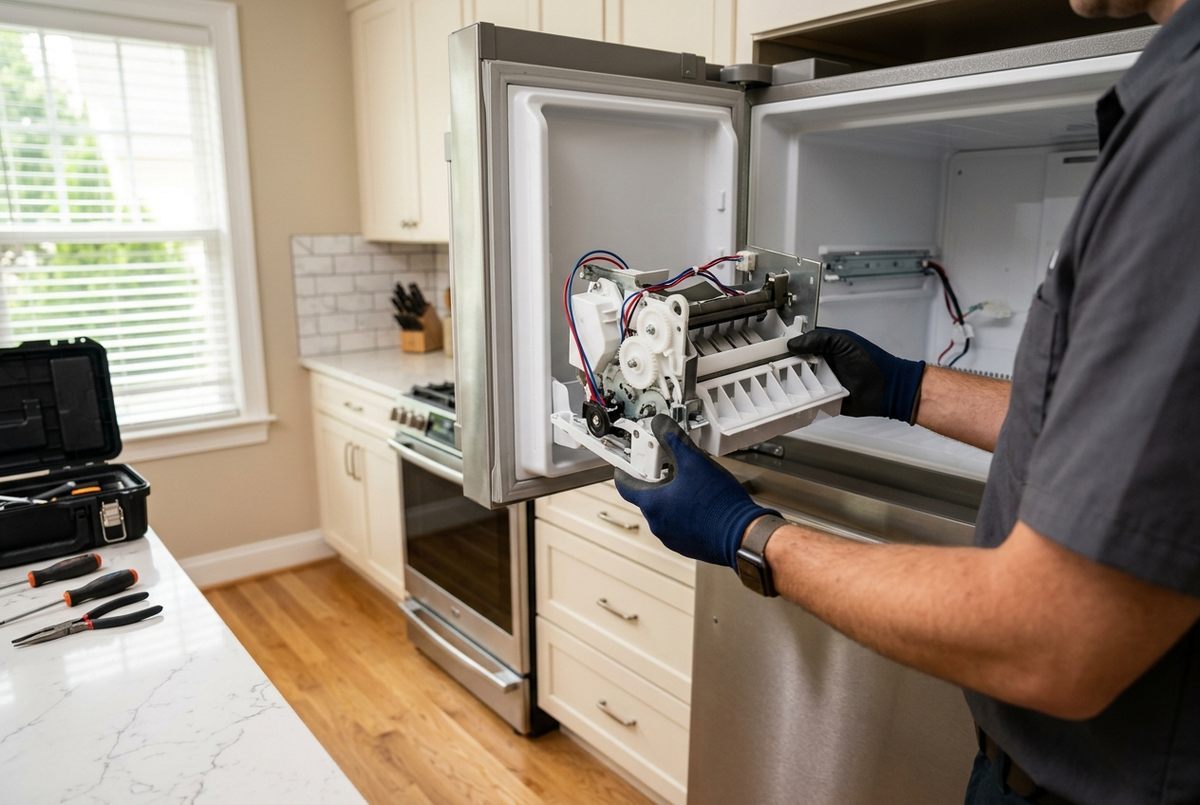
The ice maker symptoms we hear most
- No ice at all, bin's been empty for a week Inlet valve failure, a frozen fill line, or a shut-off arm stuck in the up position
- Cubes are tiny, half-formed, or hollow Low water pressure, a partially blocked fill tube, or a scaled-up inlet screen
- Water's pooling under the crisper drawer A leaking inlet valve, or a cracked fill cup letting overflow run down the liner
- Ice smells like last night's leftovers Filter past due, stale cubes absorbing odor, or a freezer door seal that's giving up
- It grinds and clunks but nothing drops Seized ejector motor, jammed auger, or cubes fused into one block in the bin
Safe things to check first
Worth a look before you call — sometimes it saves you the visit.
- 1Find the wire shut-off arm or paddle switch and make sure nothing in the bin is holding it up.
- 2Follow the water line behind the fridge and look for a sharp kink where the unit got pushed back against the wall.
- 3Check the date on your water filter. A plugged filter starves the ice maker before you notice anything wrong with the drinking water.
- 4Set a glass under the dispenser and see whether water flows normally, which tells us if the problem is water or freezing.
Guides & troubleshooting
What homeowners get from an independent shop
| Steve's Appliance Repair | Big-box repair chains | Handyman listings | |
|---|---|---|---|
| Written quote before any work | ✓ | ✕ | ✕ |
| Phones answered by people, every day | ✓ | ✕ | ✓ |
| Every major brand, gas or electric | ✓ | ✓ | ✕ |
| No manufacturer targets to hit | ✓ | ✕ | ✓ |
| Crews familiar with homes like yours | ✓ | ✕ | ✓ |
After the visit, in their words
“Two visits, one for diagnosis, one with the ordered part. Both on time, both explained clearly.”
Hannah B.Clinton Township, MI“My tenants dealt with them directly and the whole repair happened without me leaving work.”
Victor A.Lee's Summit, MO“The dryer vent was packed solid. Airflow now is night and day, and towels dry in one cycle.”
Joyce E.Carmel, INIce Maker Repair — quick answers
How long should a new ice maker take to start producing?
Give it about twenty-four hours after installation or a reset. The freezer has to hold steady near zero degrees before the mold thermostat will trigger a harvest cycle. Early cubes are often small, so toss the first two batches.
Why does our ice taste like the freezer?
Cubes absorb odors when they sit too long, or when the door seal leaks humid air in. Empty the bin, wash it with mild soap, and replace the water filter. If the taste comes back fast, look at the seal or the supply line.
Is it worth repairing an ice maker in an older refrigerator?
Often yes. On most units the ice maker module, inlet valve, and fill tube are serviceable parts. We look at the condition of the rest of the fridge too and give you an honest read on whether repair makes sense.
Our water is very hard. Does that shorten ice maker life?
It does. Scale builds inside the fill tube and on the inlet valve screen, flow drops off, and you get stunted cubes. Regular filter changes help. So does having the water path cleaned out during a service visit.
The ice maker froze into one solid block. What happened?
Usually slow usage plus a slight water leak. Cubes partly melt and refuse together, or the fill valve seeps after the cycle ends. We thaw it, then track down the source so it doesn't come back next month.
Do you work on standalone and under-counter ice machines?
Yes. Undercounter units and portable makers use different pumps and drains than a refrigerator module, but the failures fall into the same families: water in, freeze, harvest. Tell us the style when you call us so we bring the right parts.
How it works
- Step 1
Tell us the symptom
Call us or fill out the form and describe what you hear, smell, or see. An error code helps. So does a puddle. We ask the brand and rough age so the van carries the parts we are likely to need.
- Step 2
We come look
Our technician tests the machine instead of guessing: water lines, heating elements, drain pumps, control boards. Then we explain what failed in plain words before any wrench turns.
- Step 3
Repair and clean up
Common parts ride with us, so a lot of repairs finish on that first visit. Special-order parts get scheduled right away. We run the cycle with you standing there, then haul off the old part and the packaging.
- A real person answers
- Open 7 days
- Written quote before work starts
Why homeowners call us
- Hard water is our specialtyMidwest water leaves scale on everything it touches. Crusted dishwasher spray arms. Clogged ice maker lines, and washers and water heaters full of mineral buildup. We know what that grit does to valves and seals, so we treat the cause instead of the symptom.
- Basement laundry roomsBasement setups fail differently than upstairs ones, between the long drain runs, the cold concrete, and lint packed into a vent that runs through the rim joist. We check the venting and the drain path too, not only the machine, so the same problem does not come back.
- Freeze-thaw season readyGarage freezers quit in January. Ice makers stop when the supply line freezes, and dryers labor when the vent hood ices over. Seasonal swings break appliances in fairly predictable ways, and those are the first things we look at on a winter call.
- Independent, all major brandsWe are not tied to any manufacturer, so we work on whatever is sitting in your kitchen or laundry room: refrigerators, ranges, dishwashers, washers, dryers, freezers. One shop, one call, whatever badge is on the door.
- All major brands, gas & electricIndependent service on Whirlpool, LG, Samsung, GE, Maytag, Bosch, KitchenAid and the rest.
- Straight answersIf it isn't worth repairing, we'll say so, often right on the phone.
Ice Maker Repair
Small faults become big ones on a schedule of their own
Describe the symptoms and we'll book the visit — takes about a minute.
- A real person answers
- Open 7 days
- Written quotes
- All major brands
- Gas & electric
Rather not call? Get a free quote →